What is a Capybara? – Interesting Capybara Facts For Kids!
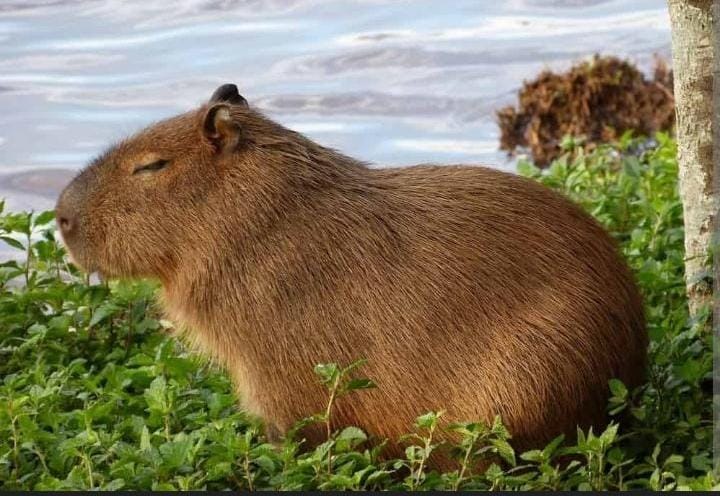
The Capybara is the largest and heaviest rodent in the world. You probably recognize this cute animal from the movie “Encanto” or the memes of the Capybara called Gort. This animal resembles a super large guinea pig and can sometimes weigh up to 132 pounds or 60 kilos and grow up to 47 inches or 120 cm long. You can easily recognize the Capybara by its facial expression: the animal always looks disinterested or grumpy. Or maybe it’s just very relaxed; after all, it also likes to be used as a chair or lift by birds or turtles.
Capybaras are found in South America. They usually live in pairs or family groups on the banks of swamps, lakes, and rivers. They are mainly found in forested areas. What does a Capybara eat? The Capybara is a herbivore, which means that it lives on plants. As its name ‘capybara’ (grass eater) suggests, grass is a favorite meal. It also enjoys water plants, as well as fruit and tree bark.
They are picky in their menu choice and don’t like every plant. Furthermore, like guinea pigs, rats, and rabbits, capybaras practice coprophagy: they eat part of their own excrement. Like humans, capybaras cannot produce the vitamin C they need to stay healthy. In the wild, capybaras eat a diet that provides them with vitamin C. However, if the animals are in captivity, active care must be taken to ensure they get enough vitamin C.
Habitat of the Capybara
The Capybara originates from South America. This is also where you can still find the Capybara in the wild. They are also often found in captivity in South America, where they are kept for their fur and sometimes for their meat. In some countries in South America, it is unusual to eat capybara meat, while in others, it is considered an important source of protein.

Capybara as a Pet: Is That Possible?
Before we go any further, please hit the like button and subscribe. It really helps support our channel so we can make many more videos for you to learn everything about the cutest animals in the world! You can find videos on YouTube of Americans having a capybara as a pet: in the pool, sunbathing in the garden, or being close to dogs or cats, etc. Although it is illegal in several states in the US to keep capybaras as pets, the Capybara is occasionally kept as a pet in America.
All in all, we would never recommend keeping a capybara as a pet. Providing the animal with a fine capybara life in captivity is very difficult. Even if it is allowed in some countries or states, it is always possible that it could still become illegal. If you want to see the animals in real life, visit a zoo where they can often be admired. I am also wondering, what is your favorite animal you have ever seen in the zoo? Please leave a message in the comment section below, and maybe we will make a video of your favorite animal!
Can Capybaras Swim?
Capybaras like water because they need to keep their skin moist. They are found only in areas such as estuaries, swamps, riverbanks, and near streams in Central and South America. Water provides the Capybara with all the means to subsist, protection against natural predators, a means for reproduction, entertainment, and food. The Capybara is a herbivorous animal; around water, it finds all kinds of herbs and plants to eat. When a capybara sees danger, it warns the rest of the group with a sound similar to barking.
Then the other capybaras jump into the water at tremendous speed. They can swim underwater and remain in the water for up to five minutes without breathing. The genus to which the Capybara belongs (Hydrochoerus) is related to the habits of that animal and means “water pig.” Water is an essential part of the life of the Capybara. It is in all its environments; in fact, you have within reach the Amazon River, considered the largest river in the world in terms of water volume.
From an early age, capybaras are adept at the water. Capybara puppies are very daring. They want to swim in the first week of life. Always alert, the mother capybara only allows the feat in shallow water and is always on the lookout. Capybaras like to swim and are good jumpers. They have intense activity at the beginning and end of the day. The Capybara’s feet have a totally optimal design for swimming; its legs are wide, its toes are quite defined and open between them, and you can appreciate the membrane that joins the toes.
This type of characteristic in semi-aquatic animals is called interdigital membranes; many amphibians, birds, and mammals that adapt to swimming have it. Besides swimming well, the Capybara also feeds mainly on plants in the water. This is another reason the Capybara loves the water, and it spends almost all day eating or playing in the water.
Why Do People Hunt the Capybara?
Because of the damage that capybaras cause to crops, these animals are hunted by the indigenous people. The Capybara is also hunted because of the subcutaneous fat layer that is rich in iodine. People are bothered by capybaras in a residential area in the Argentine city of Buenos Aires. They walk through the gardens and gnaw at all the plants. In some gardens, there are as many as 25. The reason there are so many capybaras is because their habitat is shrinking. Also, there are fewer and fewer predators that hunt the capybaras.
Reproduction
A baby capybara resembles an adult guinea pig. With a weight of 1,000 grams, it is just as heavy as its small cousin. Capybaras can reproduce at 22 months of age and get pregnant once a year. The female Capybara has a gestation period of 130 to 150 days and usually gives birth to between 2 and 8 young Capybaras. The hairy young are born on dry land, separated from the group.


